May 28, 2026 • 14 min read
LLM Wiki vs Traditional Knowledge Base: A Better Architecture for Reliable Enterprise AI
A traditional knowledge base can help a human support agent find an answer. But an AI assistant needs something stricter: current facts, clear provenance, permission boundaries, version history, and tests that prove an answer is safe to use.
That difference matters because enterprise AI systems do not merely “read” knowledge the way humans do. A human agent can notice that a help article is outdated, compare two policy pages, ask a manager when the refund rule is ambiguous, or avoid overgeneralizing from an internal SOP. A customer-facing AI assistant, unless carefully designed and evaluated, may turn the same messy knowledge base into a confident but unsupported answer.
This is why more enterprise teams are moving beyond the idea of a static knowledge base and toward an “LLM Wiki” or governed AI knowledge layer. The point is not to replace every existing KB tool. The point is to make enterprise knowledge usable by AI systems that must retrieve, reason, cite, refuse, escalate, and improve over time.
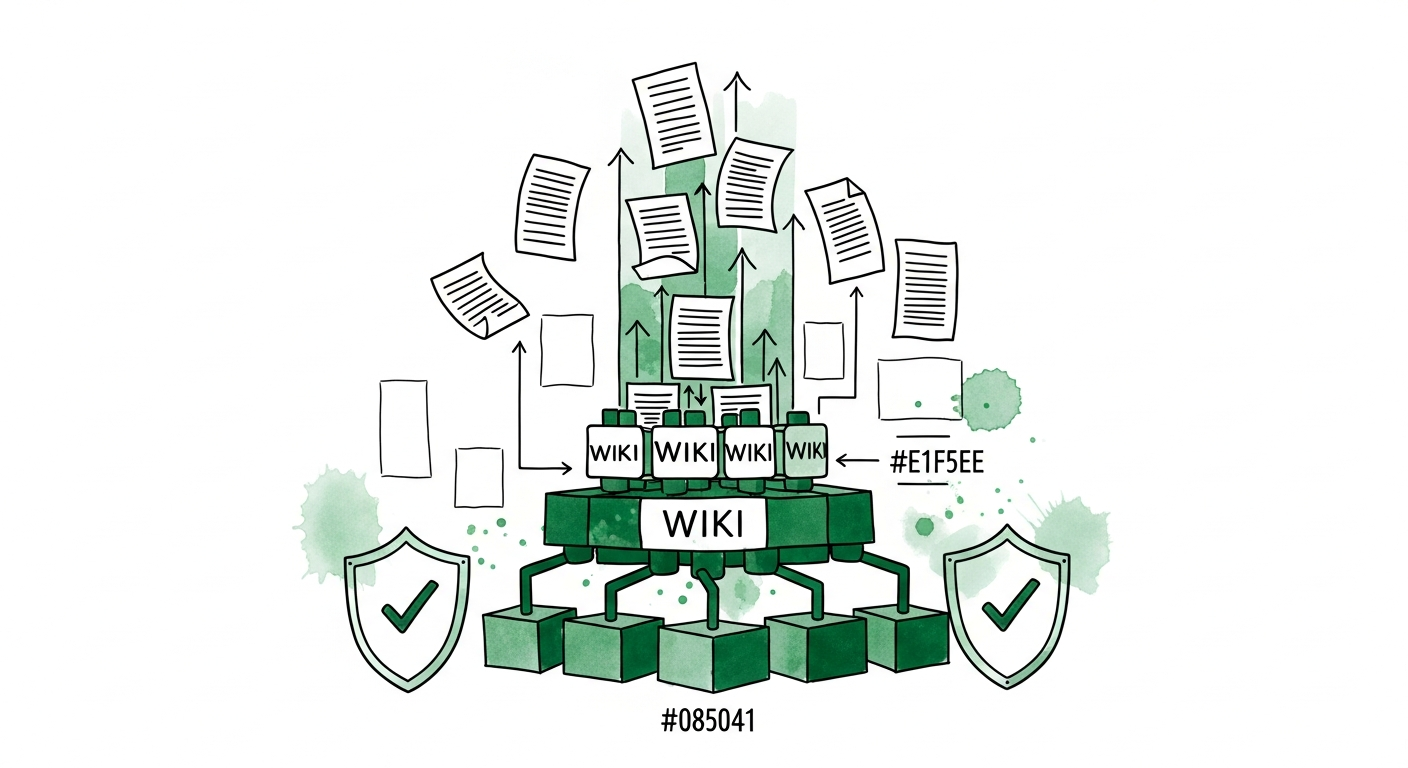
For CX teams, the question is no longer: “Do we have the answer somewhere in the knowledge base?”
The better question is: “Can our AI system find the right version of the right answer, prove where it came from, respect permissions, know when not to answer, and pass regression tests after the knowledge changes?”
Traditional knowledge bases were not designed for autonomous answers
Traditional knowledge bases are usually optimized for human lookup. They are article-centric, searchable, and often organized around categories such as product, policy, troubleshooting, billing, or onboarding. That can work well for human agents because humans bring judgment to the retrieval process.
A human can interpret nuance:
- This warranty article applies to hardware, not software subscriptions.
- This refund policy changed last quarter, so the older FAQ should not be used.
- This escalation playbook is internal-only and should not be exposed to customers.
- This help article is directionally useful, but it does not answer the specific question.
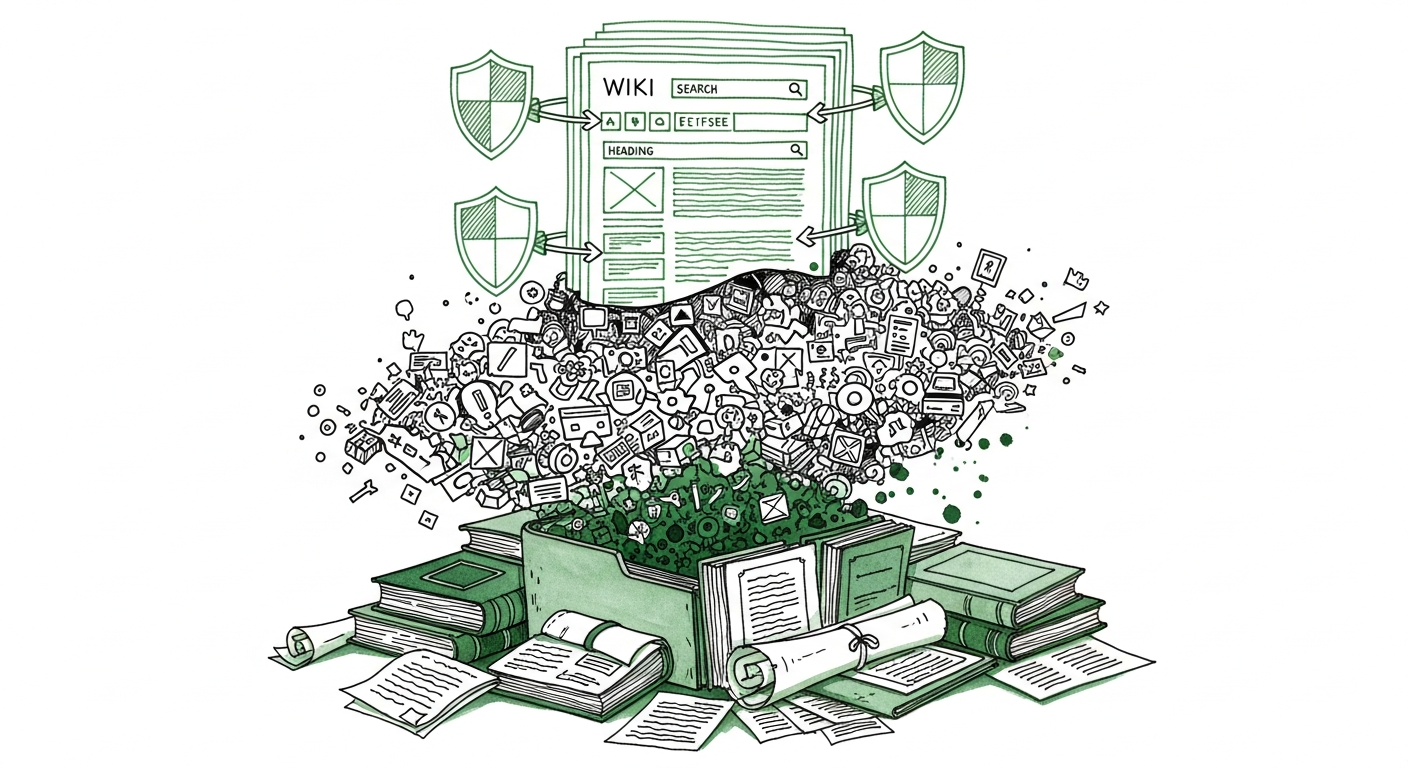
An AI assistant does not automatically make those distinctions. If the underlying knowledge system contains stale articles, duplicated policies, conflicting regional rules, missing ownership, or weak metadata, the AI layer can turn those weaknesses into customer-facing risk.
This is especially important for RAG systems. Retrieval-Augmented Generation was introduced as a way to combine a generative model with an external retriever, making responses more updateable and grounded than model-only generation. But RAG also creates an operating problem: the quality of the answer depends on ingestion, chunking, retrieval, context assembly, generation, citation mapping, and monitoring — not only on the language model.
In other words, a traditional KB may be good enough for humans to browse, but still not ready for AI to answer from autonomously.
What an LLM Wiki should mean
“LLM Wiki” is sometimes used loosely, so it is worth defining carefully. It should not mean dumping documents into a vector database and hoping the model can sort it out. It should mean a living operational knowledge layer designed for AI-assisted work.
A useful LLM Wiki has seven properties.
1. Atomic, source-backed knowledge
Traditional KB articles often mix facts, explanations, caveats, examples, historical notes, and internal guidance in one long page. That is readable for humans, but difficult for retrieval systems.
An LLM Wiki should separate canonical facts from supporting explanation. For example:
- Canonical fact: “Standard refund requests must be initiated within 14 days of purchase.”
- Applicability: “Applies to self-serve subscriptions in India and the United States.”
- Exceptions: “Enterprise contracts follow contract-specific refund clauses.”
- Source: “Billing policy v4.2, approved by Finance and Legal.”
- Effective date: “2026-04-01.”
This structure makes it easier for the AI system to retrieve the exact rule, cite the source, and avoid overgeneralizing.
2. Provenance and ownership
For enterprise AI, a claim is only as useful as its source. Provenance should answer:
- Where did this fact come from?
- Who owns it?
- When was it last reviewed?
- Which source system is authoritative?
- Which customer segments, products, regions, or channels does it apply to?
Without provenance, the AI assistant may retrieve a plausible answer from a page that is not authoritative. In CX, that can become a refund error, warranty mistake, compliance issue, or escalation failure.
3. Versioning and freshness
Knowledge changes continuously: policies evolve, products ship, SLAs change, promotions expire, regulations shift, and support workflows improve. A reliable AI knowledge layer must track version history and freshness.
Freshness should not be treated as a vague “last updated” timestamp. The system should know which version is currently active, which older versions should no longer be used, and which answers require recency checks before generation.
For example, if a customer asks about a refund window, the AI assistant should not simply retrieve the most semantically similar policy paragraph. It should retrieve the current applicable policy, understand the effective date, and avoid citing superseded rules.
4. Permission and tenant awareness
Enterprise knowledge is not uniformly accessible. Internal SOPs, customer-specific contract terms, HR policies, regulated workflows, partner documentation, and security runbooks may have different access boundaries.
A governed LLM Wiki should preserve those boundaries before the model sees the context. Permissions cannot be left to the model’s discretion after retrieval. If a customer-facing assistant should not access internal escalation notes, those notes should not enter the prompt.
This becomes even more important in multi-tenant systems, where one customer’s contract, policy exception, or support history must never influence another customer’s answer.
5. Retrieval metadata
Vector similarity is useful, but similarity is not authority. A paragraph can sound relevant while being obsolete, region-specific, product-specific, or intended for a different audience.
An AI-ready knowledge layer should enrich content with retrieval metadata such as:
- Product or service line
- Region and language
- Customer tier or contract type
- Effective date and expiry date
- Policy owner
- Risk level
- Source system
- Public vs internal visibility
- Related entities, concepts, and dependencies
This metadata helps retrieval move from “what sounds close?” to “what is the authoritative answer for this user, in this context, right now?”
6. Evaluation hooks
A traditional KB is often judged by article views, search success, deflection rate, or agent feedback. Those are useful, but AI systems need additional tests.
An LLM Wiki should support evaluation hooks:
- Which questions should this fact answer?
- Which questions should it not answer?
- What citations are acceptable?
- What answer should be refused or escalated?
- What regression tests should run when this fact changes?
Modern RAG evaluation frameworks distinguish retrieval quality from generation quality. A practical evaluation should measure whether the retrieved context was relevant, whether the generated answer was faithful to that context, whether citations supported the exact claim, and whether the system refused unsupported questions.
7. Feedback loop into operations
A governed knowledge layer is not a one-time migration project. It is an operating model.
When the AI assistant fails, the failure should be routed back into the knowledge system:
- Was the source missing?
- Was the source stale?
- Was the right document retrieved but the answer unfaithful?
- Was the citation real but not supportive?
- Was the question unanswerable and should have been refused?
- Was a human escalation rule missing?
This feedback loop turns AI failures into knowledge operations improvements.
Why vector search alone is insufficient
Many enterprise AI pilots begin with a simple pattern: upload documents, split them into chunks, embed the chunks, retrieve the most similar chunks for a query, and send them to an LLM.
That can be a useful starting point. It is not enough for reliable enterprise CX.
Vector search is based on semantic similarity. But enterprise answers often depend on authority, structure, relationships, freshness, and permissions. Similarity alone cannot reliably answer questions such as:
- Which policy overrides the other?
- Which region does this rule apply to?
- Which document is authoritative when two articles conflict?
- Which product version is the customer using?
- Is this answer safe for a customer, or only for an internal agent?
- Does this source actually support the generated claim?
This is where graph-based and wiki-like approaches become useful. Knowledge graphs and GraphRAG-style patterns can model entities, relationships, policies, dependencies, and provenance more explicitly than flat chunks. Industry discussions around GraphRAG often emphasize that enterprise knowledge is not just a pile of text; it contains relationships among customers, products, policies, procedures, contracts, and risks.
But the important point is not “GraphRAG solves trust.” That would be too broad. The practical point is that reliable AI knowledge systems need more structure than naive vector search provides.
A better architecture combines curated facts, article-level context, retrieval indexes, metadata filters, access controls, graph relationships where useful, citation checks, and regression tests.
Architecture comparison: KB vs naive RAG vs LLM Wiki
| Dimension | Traditional knowledge base | Naive RAG over documents | LLM Wiki / governed AI knowledge system |
|---|---|---|---|
| Primary user | Human agents and customers | AI assistant retrieving chunks | AI assistant, human agents, evaluators, and knowledge owners |
| Unit of knowledge | Articles and FAQs | Text chunks | Atomic facts, policies, entities, relationships, and source-backed explanations |
| Provenance | Often page-level or implicit | Often lost during chunking | Explicit source, owner, approval status, and authority level |
| Freshness | Manual updates and timestamps | Depends on re-indexing pipeline | Versioned, effective-dated, regression-tested updates |
| Permissions | Managed in KB UI | Often weak after ingestion | Enforced before retrieval and context assembly |
| Retrieval support | Keyword/category search | Semantic similarity | Hybrid retrieval using metadata, authority, relationships, and context |
| Citation quality | Human reader interprets sources | Model may cite retrieved text loosely | Citation must support the exact claim being made |
| Answerability | Human decides when answer is insufficient | Model may answer anyway | Explicit refusal and escalation rules |
| Evaluation | Search analytics, article feedback | Ad hoc prompt tests | Retrieval, faithfulness, citation, safety, freshness, and regression tests |
| Governance owner | Knowledge manager or CX ops | AI/product team often inherits risk | Shared operating model across CX, AI, legal/compliance, and knowledge owners |
Enterprise CX example: refund, warranty, and escalation answers
Consider a support bot answering customer questions about refunds, warranties, and escalation options.
In a traditional KB, the content might exist across several pages:
- A public refund FAQ
- An internal billing SOP
- A regional policy update
- A product-specific warranty exclusion
- An escalation playbook for high-risk complaints
- A contract-specific exception for enterprise customers
A human support agent can often navigate that complexity. A naive AI assistant may retrieve whichever chunk sounds most relevant. That can create several failure modes.
First, it may use an outdated refund window because the old article still exists and has similar wording. Second, it may apply a consumer policy to an enterprise contract. Third, it may expose internal escalation language to a customer. Fourth, it may cite a real document that does not actually support the answer. Fifth, it may answer a question that should have been escalated because the source does not cover the customer’s case.
In an LLM Wiki architecture, the same workflow is handled differently.
The refund rule has an owner, effective date, region, product scope, customer tier, and authoritative source. The warranty rule is linked to product entities and exclusions. The escalation rule is marked internal-only. The retrieval layer filters by customer context and permission boundary. The answerability layer checks whether the sources are sufficient. The citation layer verifies that the cited source supports the exact claim. The evaluation suite includes real support questions and edge cases, so updates to the policy trigger regression tests before the bot changes behavior in production.
The result is not a magic guarantee that the AI never fails. The result is an operating model where failures are measurable, traceable, and reducible.
A practical migration path from KB to LLM Wiki
Enterprise teams do not need to rebuild their entire knowledge estate at once. The practical path is incremental.
Step 1: Inventory high-risk knowledge
Start with topics where wrong answers create customer harm, cost, or compliance exposure:
- Refunds and cancellations
- Warranty and returns
- Pricing and billing
- Account access and security
- Regulated product claims
- Legal, medical, financial, or compliance-sensitive guidance
- Escalation and complaint handling
These are the best candidates for AI readiness work because the value of reliability is clear.
Step 2: Identify authoritative sources and owners
For each high-risk topic, determine the source of truth. If multiple documents conflict, resolve the conflict before connecting the content to an AI assistant.
Every critical policy should have an owner, review cadence, effective date, and approval path.
Step 3: Split canonical facts from explanatory content
Keep human-readable articles, but extract the facts that AI systems must use precisely. For example, separate the refund window, eligibility criteria, exceptions, region, customer tier, and escalation rules from the explanatory article around them.
This improves retrieval, citation, and testing.
Step 4: Add retrieval metadata and permission rules
Tag content with metadata that affects answer correctness: product, region, language, customer tier, effective date, risk level, source system, and visibility.
Do not rely only on similarity search. Use metadata filters, authority signals, and permission checks before content enters the model context.
Step 5: Build an evaluation set from real support questions
Use real or representative CX questions to test the system. Include normal cases, edge cases, unsupported questions, stale-policy traps, multilingual questions, and prompt-injection attempts.
Evaluate the pipeline separately:
- Retrieval: did it fetch the right source?
- Generation: did the answer stay faithful to the source?
- Citations: did the cited evidence support the exact claim?
- Answerability: did the system refuse or escalate when sources were insufficient?
- Freshness: did it use the current policy version?
Step 6: Run regression tests after every knowledge change
Every KB update, prompt change, retriever change, model change, index refresh, or policy update is a regression risk event.
A reliable enterprise AI system should not wait for customers to discover broken answers. It should test high-risk intents before release and monitor failures after deployment.
Suggested architecture: governed knowledge layer for CX AI
A practical enterprise architecture looks like this:
Source systems and documents
  ↓
Canonical fact layer / LLM Wiki
  - source-backed facts
  - owners and approval status
  - effective dates and version history
  - permissions and tenant boundaries
  - product, region, language, and risk metadata
  ↓
Retrieval and reasoning layer
  - hybrid search
  - metadata filters
  - graph/entity relationships where useful
  - reranking and context assembly
  ↓
Evaluation suite
  - retrieval tests
  - faithfulness tests
  - citation support checks
  - refusal and escalation tests
  - freshness and regression tests
  ↓
CX AI assistant
  - answers with evidence
  - refuses unsupported questions
  - escalates high-risk cases
  ↓
Monitoring feedback loop
  - failure review
  - knowledge updates
  - eval set expansion
This architecture treats knowledge as part of the AI product, not just content sitting behind it.
SafeFoundry POV: reliable AI needs a knowledge operating model
The better architecture is not “wiki instead of knowledge base.” It is a layered knowledge system: curated canonical facts, provenance, version history, retrieval metadata, access controls, answerability rules, and continuous evaluation.
For enterprise CX leaders, this shift is practical rather than theoretical. If your AI assistant is answering customers, your knowledge layer must be governed like production infrastructure.
That means:
- Critical policies need owners.
- Sources need provenance.
- Answers need citations that support the exact claim.
- Retrieval needs freshness and permission checks.
- Unsupported questions need safe refusals or escalation.
- Changes need regression tests before they reach customers.
SafeFoundry helps enterprises assess whether their RAG, LLM Wiki, and AI knowledge workflows are ready for real CX operations. The goal is not to claim that hallucinations disappear. The goal is to measure and reduce unsupported answers, citation failures, stale-policy errors, and retrieval regressions before they reach customers.
CTA
If your CX AI is only connected to a document folder or static knowledge base, it may be demo-ready before it is production-ready.
SafeFoundry can assess whether your knowledge layer is ready for reliable, citation-backed answers — including provenance, freshness, permissions, retrieval quality, refusal behavior, and regression testing.
Use a knowledge-system assessment before rollout to find the gaps that a customer-facing AI assistant will otherwise expose in production.